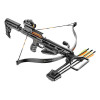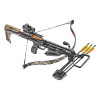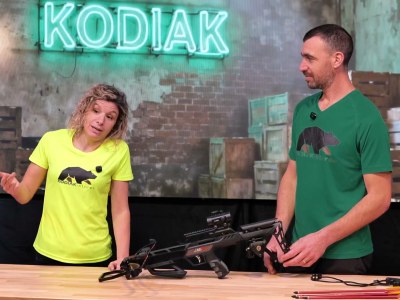
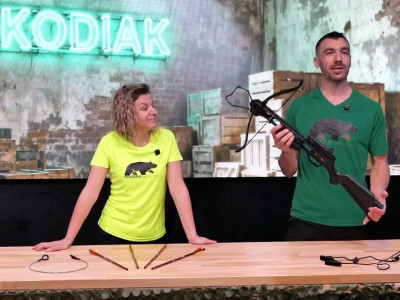


The Jaguar 2 by EK Archery — the JAG 2 — is the big sister of the Jaguar 1. Same operating logic, one step up in terms of power and comfort: 175 lbs, 260 FPS, an optic already mounted and the option of crank cocking. Anthony and Nolwenn cover it in detail in the video above; what follows summarizes the main points.
A recurve, and that is intentional
The JAG 2 is a recurve crossbow: no pulleys, no cables to monitor. Fewer moving parts means fewer adjustments and fewer possible breakdowns — a sensible choice for a crossbow you want to take out often without spending time on it.
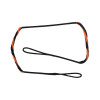
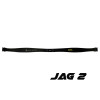
This design choice carries through to routine maintenance. The model comes with a stringer, which allows you to unload the bow and replace the string yourself without a press and without going to a workshop. On a compound crossbow, the same operation is generally handled by a gunsmith.
175 lbs for 260 FPS
The power-speed combination is the model's main selling point: 175 lbs of draw weight for an advertised exit speed of 260 FPS, approximately 79 meters per second. That is significantly above the Jaguar 1 at 175 lbs, which tops out at 220 FPS, for comparable size and handling.
In practice, this extends the usable range for leisure shooting and produces a flatter trajectory, making it easier to correct when you are just starting out.
The red dot is included, the rail takes care of the rest
The Jaguar 2 comes with its red dot already in place: nothing extra to buy to start shooting. Above the stock, a 21 mm Picatinny rail accepts most sighting accessories on the market directly, without an adapter. Switching to a magnifying scope later therefore requires no modification.
Cocking with the cocking rope
The cocking rope is included with the crossbow. The procedure, detailed in the video, takes just a few steps:
- place the crossbow on the ground and secure your foot in the stirrup, at the front;
- place the hooks of the cocking rope on either side of the stock, on the string;
- grip both handles, arms extended and back straight, then pull in one smooth motion until the click;
- remove the cocking rope and check that the safety is properly engaged.
At 175 lbs, the effort is real: it is the fastest method, but it requires a minimum of build and a healthy back.
Or with a crank, as an option
That is the real difference from the Jaguar 1: the JAG 2 accepts a crank cocking device. The principle is simple — attach the cocking device to the rear of the stock, hook the strands onto the string, then turn the crank until it clicks.
It is slower than using a cocking rope, but the effort becomes negligible. Three groups benefit noticeably: shooters with back or arm problems, people of small stature, and anyone who fires a large number of shots in the same session.
Load and shoot
Loading follows the standard crossbow rule: the bolt is placed in the rail groove, colored vane facing down, in the channel, with the nock making solid contact with the string. The safety is only released once the crossbow is shouldered and aimed at the target.
Maintenance comes down to two steps
Nothing special to plan for, but nothing to overlook either: every 5 to 10 shots, you need to wax the rail and lubricate the string. These two steps determine the lifespan of the string, which rubs against the rail with every shot.
When it shows signs of wear, the string can be replaced on its own; the bow is also available as a spare part.
What the law says in France
- crossbow hunting is prohibited on French territory: the Jaguar 2 is a leisure weapon, to be used on targets;
- sale is restricted to adults;
- for transport, the crossbow must be disassembled or fitted with a trigger guard lock.
Black or camo, and who is it for?
Two finishes are available in the catalog: the black version, around €160, and the camouflage version, slightly above €180. Everything else is identical.
The Jaguar 2 is aimed at the leisure shooter who wants speed without entering the world of compound bows, and at those who need crank cocking. For a first crossbow with upgradeable power, the Jaguar 1 remains the entry point of the EK Archery range.